County / Braga / Guimarães / Castelo de Guimarães
A whole country
to discover!
to discover!
Castelo de Guimarães
Archaeological Sites
Archaeological Sites
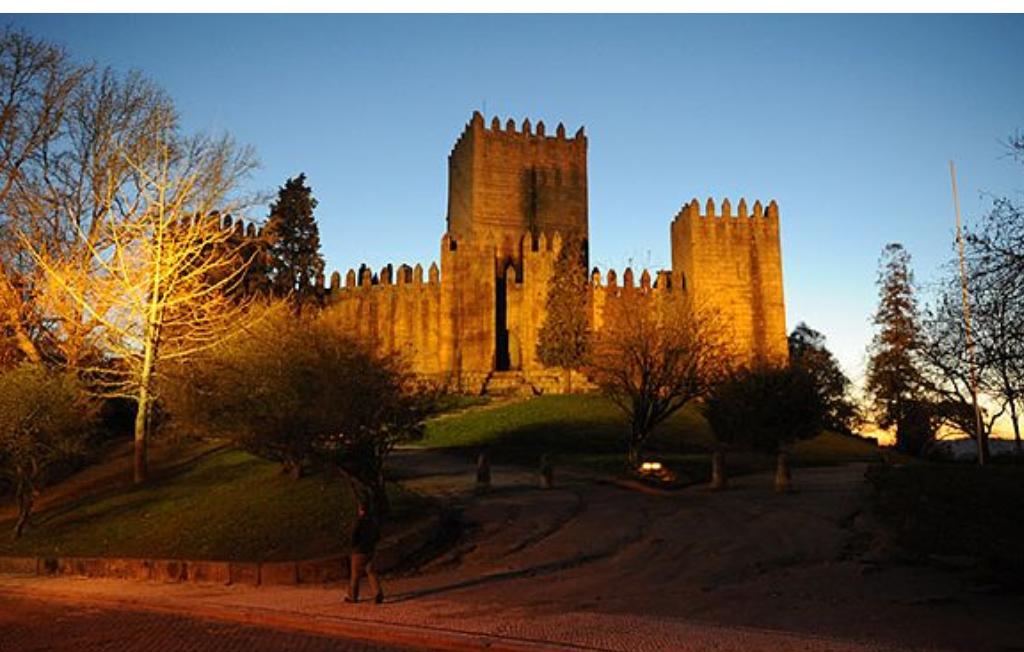
Recognized by many as the castle that is most closely linked to the origins of Portugal, Guimarães Castle is a surprising structure in several respects. Firstly, its origins are particularly obscure. It is certain that this is a county structure, the result of the initiative of the emblematic countess of Portugal, D. Mumadona Dias. Since it is not mentioned in a detailed document of division of assets between the countess and her children, in the mid-950s, we can assume that it did not yet exist at that time. However, at the end of that same year, 950, it is mentioned, in a donation in which the Monastery of Guimarães is mentioned as being under its jurisdiction. It is, therefore, a county foundation, from the second half of the 10th century. Countess Mumadona herself states, in a parchment dated 968, that she founded it to protect the monastery of Guimarães from attacks by the “gentiles” (probably referring to the Normans). This primitive castle, nestled between granite outcrops, must have been built of wood and few traces of it remain.
At the end of the 11th century, during the reign of Counts D. Henrique and D. Teresa, the castle underwent major renovations, of which traces remain mainly on the northern façade, facing Campo de S. Mamede, where the base of the walls shows a different phase, with large stones. These traces document a rounded enclosure. It was this castle that faced the forces of Alfonso VII of León and Castile, when the monarch laid siege to Prince D. Afonso Henriques.
In the 12th century, during the reign of our first monarch, it underwent major renovations, from which it came to encompass the current perimeter, although still without its eight towers. With the Gothic reforms, during the reign of D. Afonso III or D. Dinis (when the walls of Guimarães were being worked on), it underwent a profound renovation, which added the eight turrets on its perimeter (four of which framed the two entrance gates) and its keep.
It was in the second half of the 13th century, with the Gothic reforms, that the castle of Guimarães acquired its current form. By that time, the border of the kingdom was already too far removed, giving an increasingly secondary role to the Castle of Guimarães. However, it played a decisive role in the Civil War of 1321-24, which pitted D. Dinis against Prince Afonso, heir to the throne, which culminated in the Siege of Guimarães in 1322. And its importance was tested again in the Crisis of 1383-85, when it was besieged by the Master of Avis.
In the 15th century it still maintained some relevance, but from the end of the 15th century onwards it lost its military and strategic importance. The borders were too far apart and weapons had evolved towards pyroballistics (the “firearms”). From the early years of the 16th century onwards, Guimarães Castle experienced years of abandonment and decay. With no military function, it began to be used as a jail or prison. It was only in the 19th century that the population of Guimarães and, in their wake, the Portuguese came to terms with Guimarães Castle. From the 19th century onwards it began to be recognised as an emblematic structure of the Portuguese Middle Ages, closely associated with the process of autonomy in which it played little role. Classified as a National Monument in 1881, and included in the first heritage list that Portugal had, it acquired an undeniable emblematic value, greatly encouraged by the Estado Novo, responsible for a profound restoration intervention, carried out from 1936 and inaugurated in 1940. And today it continues to be one of the most emblematic and recognized medieval castles in Portugal.
+351 253 412 273
Call to national landline network
Call to national landline network