County / Bragança / Torre de Moncorvo / IRON MUSEUM
A whole country
to discover!
to discover!
IRON MUSEUM
Art and Culture
Art and Culture
Introduction
The Iron Museum & Moncorvo Region (MFRM) is a museological and cultural institution aimed at promoting knowledge and dissemination of the archaeological and industrial heritage of the territory, villages and communities that formed in the vicinity of the mountains of Reboredo and the Vale da Vilariça, with particular emphasis on activities related to the exploitation of iron.
Mission
The mission of the Moncorvo Iron & Region Museum is to study and preserve the archaeological and industrial heritage of the territory, and, through it, promote its dissemination, favoring a set of educational activities, with the aim of developing throughout the local community and those who visit it, a conscience that values local history.
Goals
The Museum's objectives are:
Study, preserve and disseminate the archaeological and industrial heritage of the territory in all its manifestations;
Keeping the archaeological and industrial assets under guard;
Guide younger populations towards the appreciation and enjoyment of museum spaces, promoting a critical reflection on the importance of safeguarding heritage;
Implement an interaction network with various institutions, public and private;
Establish a policy for the acquisition of assets/collections based on research, purchase and incentives for donations and loans, with museums of similar themes, private individuals and others;
Promote actions to recognize, value and preserve the archaeological and industrial heritage, material and immaterial, in institutions and communities;
Encourage the participation of educational and cultural institutions, in projects of oral tradition, publications and research, based on their histories and roots, stimulating the preservation of memories and the continuity of their activities, in MFRM projects;
Affirm the MFRM as an attraction in tourist and leisure visiting itineraries, connecting activities with others developed by local educational, social and cultural institutions;
Encourage the creation and production of publications and teaching materials to disseminate the assets and activities of the MFRM and for the training and awareness of new generations.
spaces
The Iron & Region Museum of Moncorvo is located in the Barão de Palme manor, from the 17th century. XVIII, in Largo Balbino Rego, in Torre de Moncorvo. It is a simple building, with an exterior staircase and porch veranda. The Museum has the following spaces: main building, attached garden, auditorium and area for reservation and storage. On the 1st floor of the museum building, which is accessed by an outside staircase, there is a reception station that guides the visitor to a reception area called the Knowledge Workshop. Here, the two main geomorphological accidents that influenced the economic history of the region are indicated in satellite images: the particularly fertile Vilariça valley and the Roboredo mountain range, where more than 670 million tons of iron ore (hematite) are found. and magnetite). The Vilariça valley corresponds to a tectonic fault irrigated by the river of the same name, which here meets the river Sabor, and this one with the Douro, providing human occupation since remote eras. As proof of this, an anthropomorphic stele-menhir from the Chalcolithic period (Age of Copper) is displayed in this room, measuring around 1.57 m. Also in this space, you can see other aspects of the region's heritage, through an audiovisual projection, or, alternatively, short documentaries, as well as a film from the 50s of the last century, about the work in the Moncorvo mines. Next to the Knowledge Workshop is the room dedicated to the archeology and history of the region, but which is currently used for temporary exhibitions.
In another wing of the 1.0 floor is the iron room, organized into five themes:
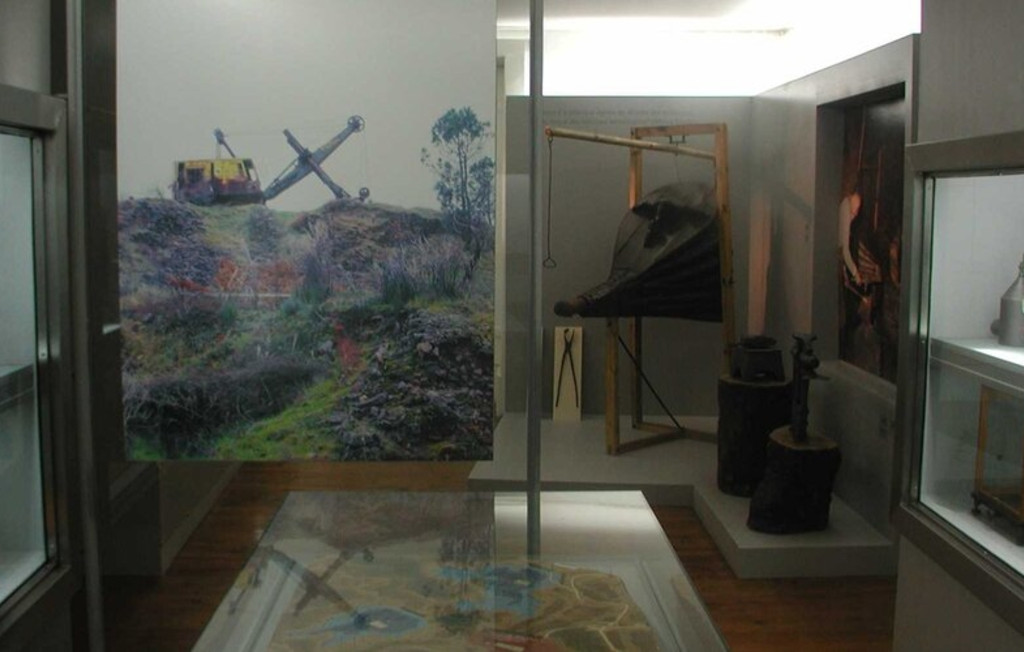
Forges, blacksmiths and smithies, in which an approach is made to the iron cycle in the pre-industry (mining, metallurgy and forge work), where objects and tools related to iron activity can be seen, from slag to blacksmith products , a bellows and other tools of the forge.
Geology and mines, with a small geological collection, reproduction of photos and documents.
Origins of the iron industry, with a diagram of the evolution of foundry furnaces and emphasis on materials from the Roman period collected in the 1950s at the Carvalhosa mine and in 1983 at the Vale dos Ferreiros slag.
Impact of the Industrial Revolution in Portugal, with reference to the proto-industrial experience of Chapa-Cunha (Mós, Torre de Moncorvo), where a Catalan forge operated, until the so-called “secondary foundries” of the 19th and 20th centuries.
The mining history of Ferrominas, the mining company that from 1951 to the 1980s dedicated itself to the extraction and export of Moncorvo ore.
Still on the 1st floor, there is the small room of the Documentation Center, where plants, various documents and specialized books are kept. On the ground floor are the reserves, containing archaeological material and metallic objects, coming from prospecting and excavations carried out in the municipality of Torre de Moncorvo. From the ground floor you can access the back of the museum, where there is a beautiful garden, populated with trees and plants from the region, over several terraces. At the end of the garden, there is a large auditorium with a semicircular layout, where numerous events are held, in accordance with the museum's cultural program: painting and photography exhibitions, lectures, etc.
Funds and Collections
The Museum features a vast collection of materials from the former Iron Museum created by the company Ferrominas, EP., where you can see various equipment used in mines in the 20th century, including laboratory pieces. In the IPPAR – COAI collection, some objects of Portuguese Industrial Archeology stand out, which are in deposit by means of protocol. The archeology nucleus consists of some Roman funerary stelae, several decorated stones from the medieval period, thousands of ceramic fragments, bones (mainly animals) and metal objects, from prospecting and excavations carried out in the municipality of Torre de Moncorvo, since the early 1980s. The geology collection stands out for its various rock and mineral samples. The ethnographic collection is made up of objects from old forges (horseshoes, shares, etc.) and agricultural implements. The Documentation Center is made up of several documentary, photographic and bibliographic funds, highlighting the Engª Monteiro de Barros fund.
(MFRM/N. Fields)
services
Exhibitions and Temporary Events
This body periodically develops exhibitions and other temporary events, such as meetings, presentations of publications, sometimes collaborating with other institutions and bodies.
Visits and Educational Services
The booking of group visits must be made at least 10 working days in advance, using the contacts provided here.
+351 279 252 724
Call to national landline network
Call to national landline network