County / Guarda / Vila Nova de Foz Côa / Large house in Freixo de Numão
A whole country
to discover!
to discover!
Large house in Freixo de Numão
Art and Culture
Art and Culture
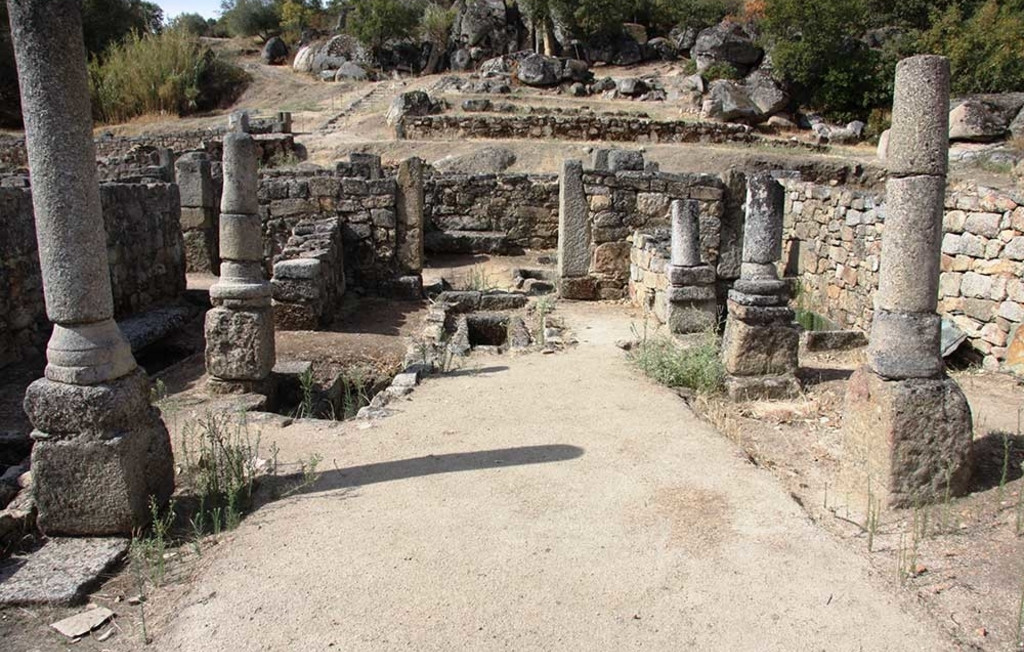
In the urban perimeter of the parish of Freixo de Numão you can visit the Museu Da Casa Grande, installed in a beautiful Baroque Manor (second half of the 18th century), with significant displays of Archeology and Ethnology. In the attached yard, Roman, medieval and modern ruins, with materials from the Iron Age still being collected there.
Imposing, as an archaeological site but also as a viewpoint, is Castelo Velho, where successive excavation campaigns have allowed the study of a village from the 3rd and 2nd millennia BC (Ages of Copper and Bronze). Fortified village or just a monumentalized site, questions that researchers today ask about the functions of such an ancestral symbol of human presence in the region.
Important remains of the Chalcolithic, we can also find them in the shelters of Vale Ferreiro and Painova. However, it is on the site of the Term that valuable traces of the Ancient Neolithic are now beginning to be exposed.
Other elevated sites such as Alto dos Barreiros, Alto de Santa Eufemia, place of the Castle of Freixo de Numão, have surprised us with findings ranging from the Chalcolithic to the Iron Age!
From the presence of the Romans, traces can be seen everywhere on the rim of Freixo de Numão and bordering. In the phase of advanced study are the rustic villas: do Term, with three occupations (1st / 2nd century AD, second half of the 3rd century AD and the Constantine era - 14th century AD); Rumansil (occupied from the second half of the third century AD to the fifth century AD); Zimbro II (with occupation from the 1st century AD to the 4th century AD; Colodreira / Escorna Bois (with occupation from the end of the 2nd century AD until the 6th century AD); among others. today the urban area of the parish of Freixo de Numão, there must have been an important castro (Iron Age), later strongly Romanized. Reference (through epigraphic findings) to gods and goddesses like Juno, lovi (Jupiter), Lares, Breaegui, Turocicis favor the suspicions of the existence of this civitns!
In a good state of repair is the 500 meter stretch of Roman pavement in place of Regadas, as well as a caterpillar dug in the rock, blacksmithing and probably Mutatio.
At the Laranjal site, a set of four caterpillars dug into the rock will tell us about the importance of that whole valley, in the era of the emperors, in terms of wine production.
from the High and Low Middle Ages, the most significant remains are found in the Medieval Church of the Deadline. Various types of graves, infra and extra-walls of the "old church", will want to indicate different times, different rituals performed by men from different times. About four dozen skeletons have been exhumed and are in the study phase.
At the bottom of the Waterways you can still appreciate a rare example of Moinho de Cubo with the date of 1715.
In addition to this valuable archaeological heritage, a very rich natural heritage, which includes the Mela Floristic Reserve, O Forno-Anta da Colodreira, the waterfalls of the Pontão das Três Bocas.
For all this, the area of Freixo de Numão (formerly S. Pedro de Freixo) deserves our visit.
+351 279 789 117
Call to national landline network
Call to national landline network