County / Lisboa / Azambuja / Parish Church of Azambuja
A whole country
to discover!
to discover!
Parish Church of Azambuja
Churches and Temples
Churches and Temples
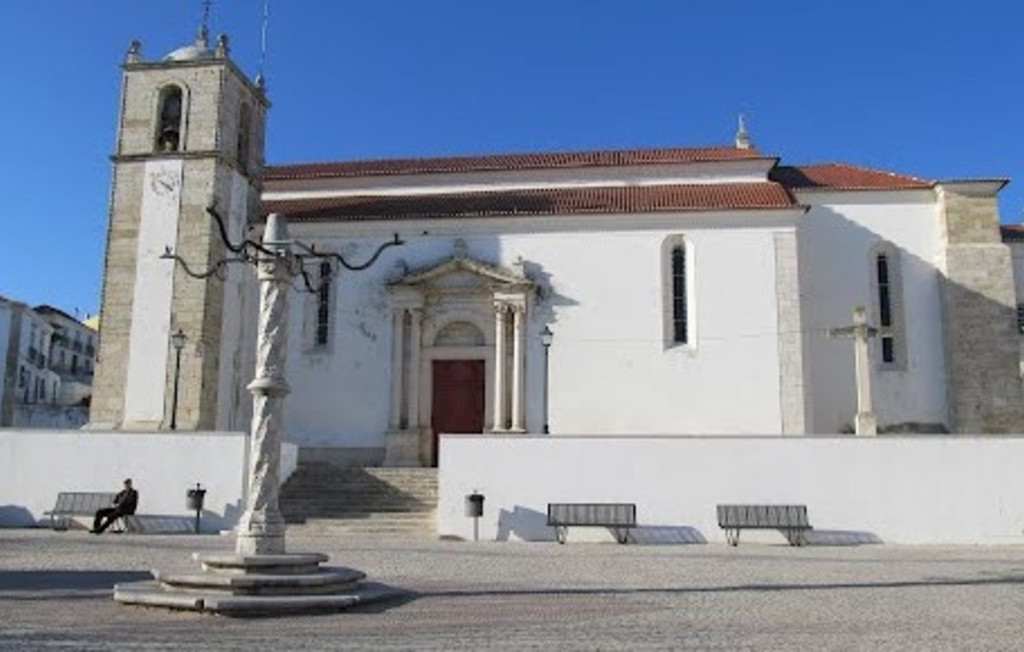
The original parish church of Azambuja was built in the 13th century, a century during which the town's population center was consolidated, donated in 1200 to King Rolim by King Sancho I. There is news that the mayor Rui Fernandes de Tavares, who in 1272 granted the first charter of Azambuja, was buried together with his wife in the parish church, so the temple would already be built on that date.
In the mid-16th century the matrix was rebuilt; the earthquake of January 1531, whose contemporary documentation claims to have caused great destruction and deaths in the Azambuja area, damaged the village's temple. In 1535, the Council for the General Study of the Kingdom donated 30,000 reais to "correct the chancel" of the parish church in Azambuja. The built temple obeys the Mannerist typology, in which the structure, both exterior, and interior, is governed by the sobriety of the constructive lines and the decorative program.
The main façade does not have any decoration, showing in the counter-curved pediment the differentiation of the nave's plank. The bell tower was added to the Epistle side and windows of different sizes were torn in the upper register of the façade.
The most prominent elements of the outer space are Serlian-style portals, the main one in a simple typology, with a rectangular frame flanked by pilasters and topped by a triangular pediment, the side presenting a less common model, in which the door is topped by a tympanum, flanked by two pairs of Corinthian columns, the whole being topped by a triangular pediment. These elements show a full knowledge of classical architecture and Italian treatise models on the part of the author of the work.
The interior space of the temple, with a longitudinal plan, is divided into three staggered naves, whose sections are separated by perfect arches supported by Tuscan columns. The chancel was modified in 1678, displaying in the center a baroque altarpiece in gilded woodwork. It maintains the 16th-century roof, a starry vault. The walls of the temple are covered with 17th-century pattern tiles, which display two different scales and decoration patterns.