County / Porto / Baião / Sacred Art Center – Monastery of S. André
A whole country
to discover!
to discover!
Sacred Art Center – Monastery of S. André
Religious Sites
Religious Sites
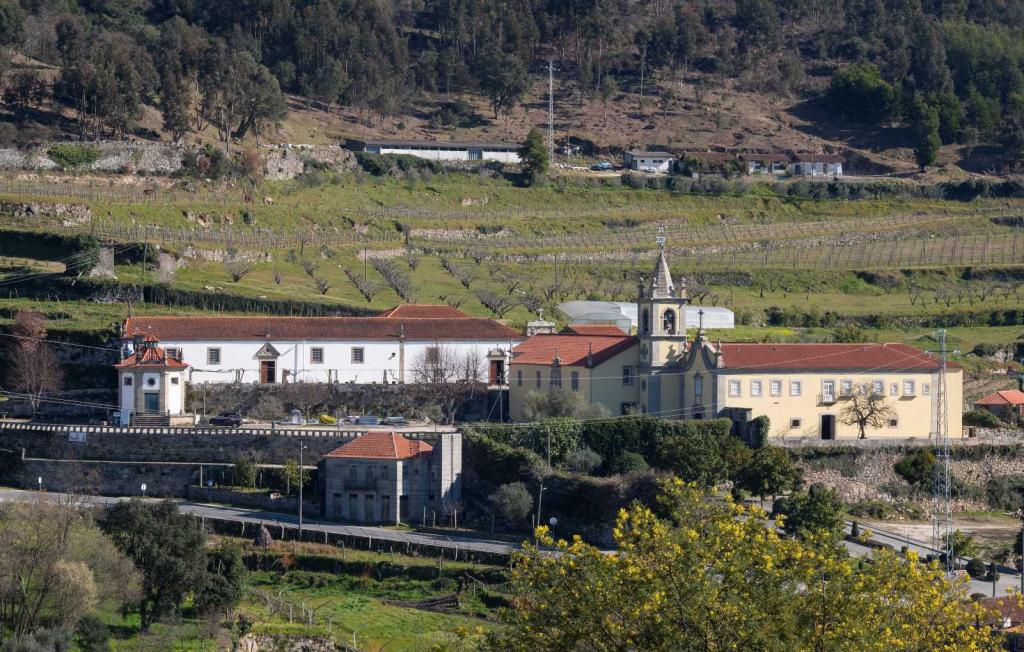
A monastic community existed in 1141, when D. Afonso Henriques granted it a charter of privileges, and settled on a hillside overlooking the Douro.
The Canons Regular of Saint Augustine turned Ancede into an important economic, cultural and spiritual centre.
This prosperity allowed investment in heritage, of which the church and the monastic complex are examples. Although the remains of the Romanesque church are limited to the rose window and the walls of the transept, its volume suggests that the medieval church was of considerable size.
It was destroyed in the 16th century when the monastery was transferred to the Dominicans. At that time, an adjoining church was built for the parishioners.
Both were destroyed at the end of the 17th century to make way for the current three-nave church. In the main chapel, Baroque and Neoclassical elements are combined with the Romanesque rose window.
In the naves, the pulpit and the choir stand out, and in the sacristy, the furniture and the set of 18th-century reliquaries.
In the churchyard, the Chapel of Senhor do Bom Despacho highlights one of the most notable periods of the Monastery: the 18th century. This Baroque chapel, with an octagonal floor plan, contains a fascinating narrative of the life of Christ.
+351 255 810 706
Call to national landline network
Call to national landline network