County / Santarém / Ourém / Main Church of Freixianda
A whole country
to discover!
to discover!
Main Church of Freixianda
Built Heritage
Built Heritage
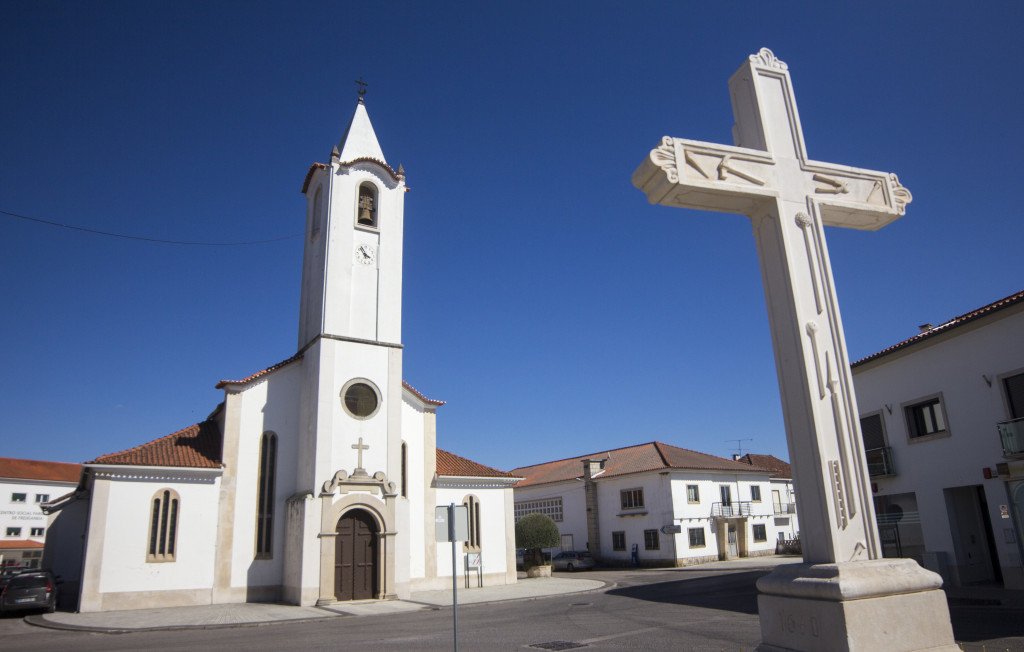
The first historical documents where this church is mentioned date from 1304, as Church of the Freixedas. According to Volume II, from the History of Fortunato de Almeida, the church of the Freixianda will have been filled with sixty pounds for the years 1320/1321. In 1445, it was annexed and incorporated into the Collegiate Church of Ourém, leaving in Freixianda a removable CURATO of the presentation of the Cabido . It later became a permanent Rectorate, by letter of erection of Cardinal D. Henrique of October 16, 1567.
In 1635, by sentence of the Provisor of the Bishopric of Leiria, it was determined that in Freixeanda there would be a perpetual vicar.
After the extinction of the Collegiate in 1850, Freixianda became the parish priest with the exclusive appointment of the Bishop of Leiria.
In 1906, when Father Faustino Jacinto de Almeida arrived in the parish, he ordered to be builr a new Main Church, since the current one was small, it was collapsing and the walls were still stone and clay. It now has three naves and a vaulted main chapel. Next to the triumphal arch there are two high niches with the images and S. Sebastião and Santo António, 17th century sculptures, two side altars and two side altars. There is also a collection of ancient images, all in stone, found "behind the throne of the high altar: Senhora da Graça or Purificação. Sixteenth-century sculpture, polychrome ", as it is referred to by Matos Sequeira.
In 1966, Father Benvenuto proceeded to a new remodeling, transforming it into a more modern church, placed one on the new altar facing the assembly, for that arrived the old altar back against the altarpiece and the platform advanced in a semicircle, on the outside raised the tower.
Subsequently, it underwent some works of requalification, such as the replacement of the old chancel because it no longer offered safety conditions and was a small space.
It is referred to in the historical records as the Church of the Purification, which is its patron saint. It performs two annual festivals, one on the first Sunday of February and the other on the first Sunday of September, in Honor of the Sacred Heart of Jesus.