County / Santarém / Santarém / Castelo de Almourol
A whole country
to discover!
to discover!
Castelo de Almourol
Built Heritage
Built Heritage
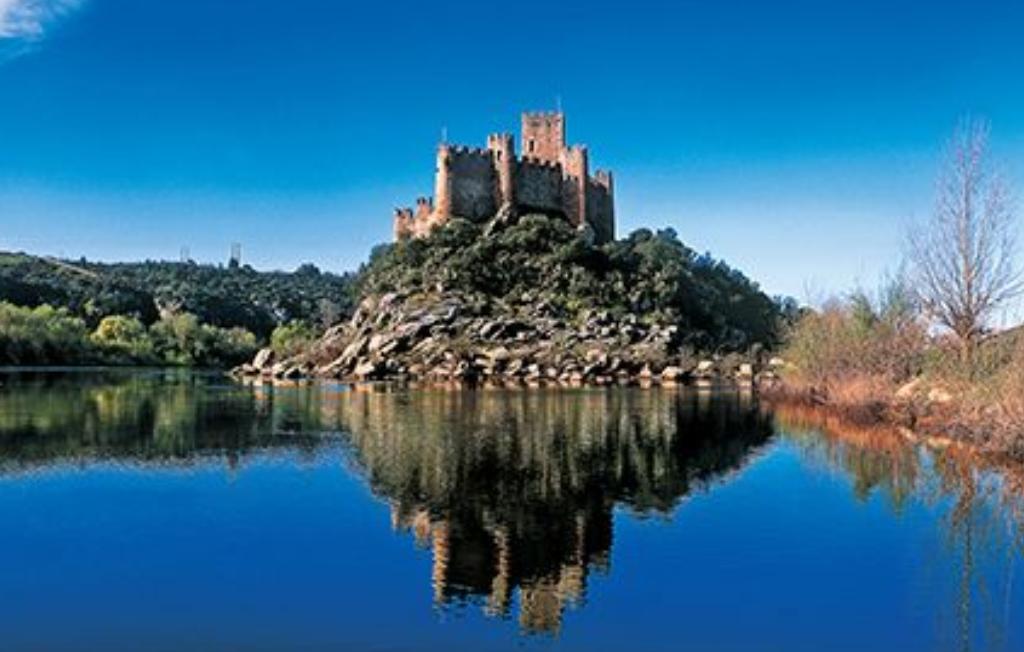
Situated on a small, steep island in the middle reaches of the River Tagus, Almourol Castle is one of the most emblematic and scenic medieval military monuments of the Reconquista, and is also one of the most important monuments to evoke the memory of the Templars in our country.
The origins of the occupation of this site are quite ancient and, for this reason, enigmatic. Some authors have suggested that a primitive Lusitanian or pre-Roman stronghold may have been established here, which was later conquered by the latter and occupied in waves throughout the High Middle Ages. Whatever the case, the fact is that in 1129, the date of the conquest of this point by Portuguese troops, the castle already existed and was called Almorolan.
Handed over to the Templars, who at the time were establishing settlements between the Mondego and the Tagus rivers, and were also the main forces responsible for the defence of the capital, Coimbra, the castle was rebuilt and assumed its essential architectural and artistic characteristics, which can still be seen today. From an inscription above the main door, we know that the works were completed in 1171, just two years after the grandiose construction of the Castle of Tomar, commissioned by Gualdim Pais, whose construction activity at the head of the Order in the 1660s and 1770s was truly astonishing. There are several characteristics that unite both, in the same line of Templar military architecture. In terms of planimetry, the option for a quadrangular layout of the spaces. In height, the high walls, protected by nine circular towers, attached to each other, and the keep, the true nerve centre of the entire structure.
These last characteristics constitute two of the innovative elements with which the Templars marked their military architecture in our country. In fact, as Mário Barroca made clear, the keep is unusual in pre-Romanesque castles, only appearing in the 12th century and in Tomar, the main Templar defensive stronghold in Portugal (BARROCA, 2001, p.107). The keep of the castle of Almourol had three floors and was significantly modified over time, but it still retains important original remains, such as the base, which gives us the general dimension of the structure. On the other hand, the walls with attached turrets, normally equipped with a rampart, were also brought to the western peninsula by this Order, and we see them used in Almourol.
With the extinction of the Order, and the re-conquest that justified its importance in medieval times, the castle of Almourol was condemned to a gradual oblivion, which was radically changed by Romanticism. In the 19th century, as part of the mental process of searching for and revaluing the Middle Ages, the castle was reinvented in the light of a romantic ideal of medievalism. Many of the original structures were sacrificed in favor of an ideology that sought to transform the most emblematic medieval monuments into true masterpieces, without parallel in the heritage heritage. The uniform crowning of battlements and merlons dates from this period, as well as numerous other elements of an essentially decorative and very impractical nature.
In the 20th century, the complex was adapted to become the Official Residence of the Portuguese Republic, where some important events of the Estado Novo took place. The reinvention process, which had begun a century earlier, was definitively completed by this intervention in the 1940s and 1950s, thus consummating the fascination that the scenography of Almourol caused in the long Portuguese cultural and political Romanticism.
+351 962 625 678
Call to national mobile network
Call to national mobile network