County / Vila Real / Sabrosa / Castro de Sabrosa
A whole country
to discover!
to discover!
Castro de Sabrosa
Archaeological Sites
Archaeological Sites
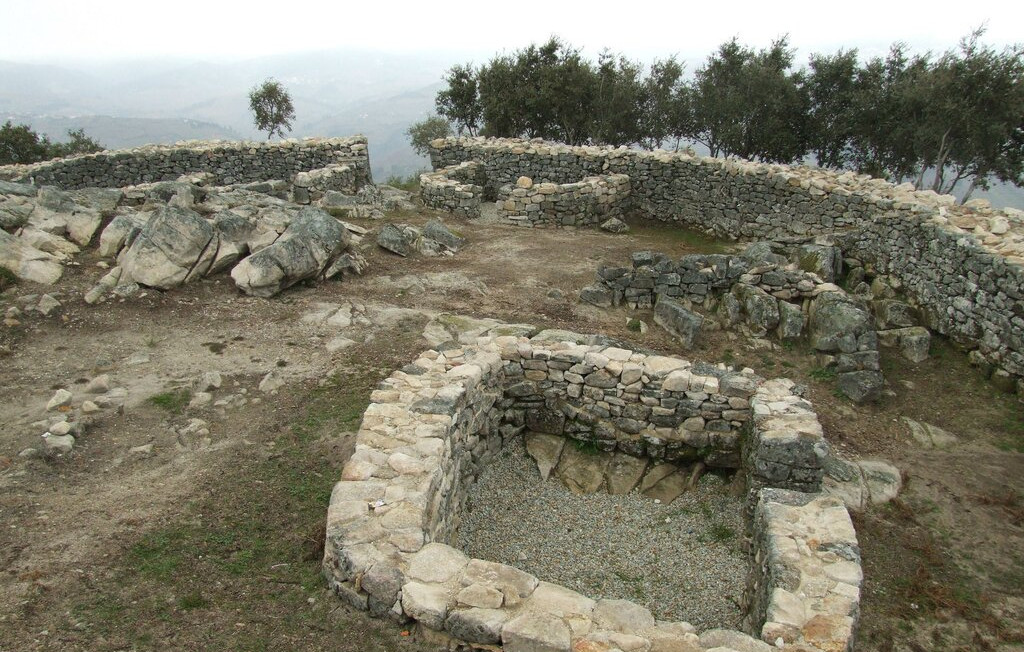
This fortified village is located in the District of Vila Real, Municipality of Sabrosa, Parish of Sabrosa, in the place of Castelo, adjacent to the eastern slope of Serra do Criveiro. It has 70 meters on its E-W axis and 123 meters on its N-S axis. It is located at an altitude of 665 meters, and its GAUSS coordinates are as follows: Meridian – 247.075 and Parallel – 478.975, and can be located through the map of the Cartographic Services of the Army, sheet number 115 – Sabrosa, with a scale of 1/ 25 000.
In Vila de Sabrosa, signposts indicate the access for vehicles and people to this archaeological site, which is located 2 kilometers to the north of it, overlooking the road that goes to Vilar de Maçada (national 323) and the Pinhão river.
There seems to have always been knowledge of the existence of Castelo da Sancha, another name for Castro de Sabrosa – or in other words, its existence and location seems never to have been forgotten. In addition to its historical value, the belief that somehow lies at the genesis of the formation of the village of Sabrosa is widespread, the people know and feel, seeing the ruins of this Castle, the old, truncated stories of their ancestors. We should also not forget that its importance was recognized by Decree 251/70, by which it was classified as a Property of Public Interest.
Castro de Sabrosa, whose occupation began in the Iron Age and ended in the Medieval Period, was defended by three orders of walls built with facing stones. A double ditch, outside the walls, reinforces the west and north, reinforces the defense of the most vulnerable areas of the station. The upper redoubt shows several structures: a turret, five houses, access ramps and doors.
Of the materials found there are numerous ceramic fragments, smooth and decorated, with a chronology that extends from the Iron Age to the Middle Ages, many of which were recently “rediscovered” in the deposits of the Geology Museum of the University of Trás-os-Os. -Montes and Alto Douro (UTAD). Some milky quartz sling balls were also found. A large iron axe, fibulae and Roman coins are part of the metallic loot discovered. Of the greatest interest are the 3 Roman epigraphs found: a votive altar dedicated to Jupiter and two funerary stelae – one by Latronus and the other by Op(tacius).
(Text in Dr. Huet's book - Subsidy for an inventory...)