County / Aveiro / Arouca / Monastery of Santa Maria de Arouca
A whole country
to discover!
to discover!
Monastery of Santa Maria de Arouca
Religious Sites
Religious Sites
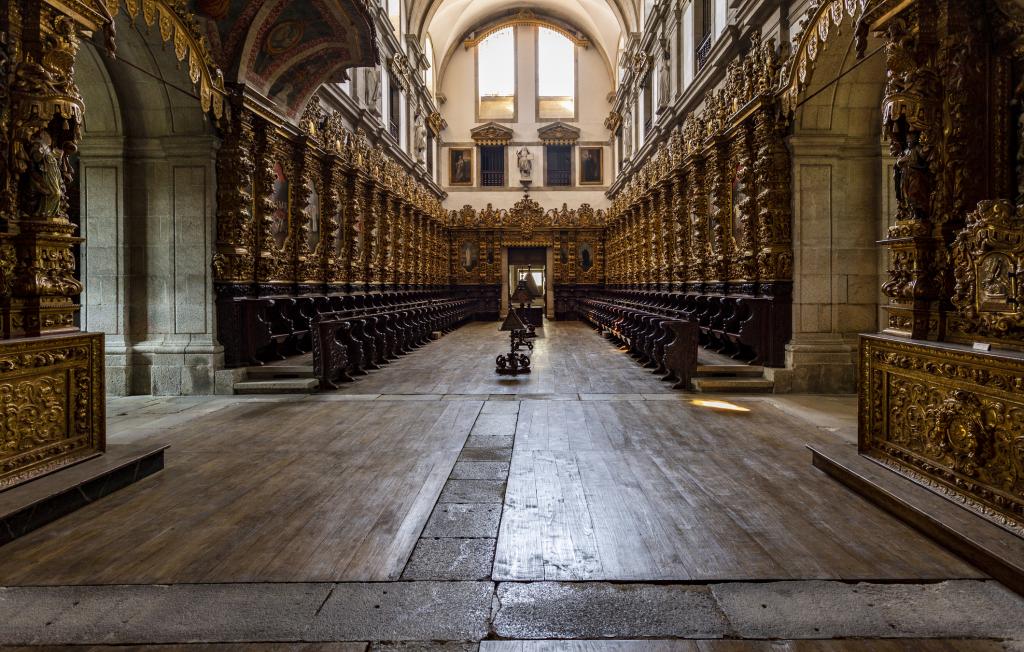
Originally built in the 10th century, this building has undergone profound transformations. Thus, the structure we see today is the result of changes made throughout the 17th and 18th centuries. His monastic activity was the driving force behind the economic, social and gastronomic development of the municipality, which grew around him.
The Monastery of Santa Maria de Arouca is divided into two parts: the North wing, made up of the Church and the choir, and the east and west wings. You can freely visit the Church at any time of the day.
The remaining spaces can also be visited, but are subject to opening hours.
Exclusively female from the 12th century onwards, this monastery was the home of one of the granddaughters of the first King of Portugal, D. Mafalda, responsible for the transition to the Cistercian Order. At the time of her death, the convent was one of the most important in the Iberian Peninsula.
In the 18th century, D. Mafalda's tomb was opened, discovering that her body was incorrupt, which led to her beatification. Thus, when visiting the Monastery Church, you will have the opportunity to see Dona Mafalda's body, as it was found, deposited in a glass tomb with ebony and silver ornaments.
The Monastery’s majestic pipe organ requires a careful look. If you have the opportunity, enjoy the sound of this unique piece, one of the most important preserved examples from the first half of the 18th century. It has 1352 voices, fed by 24 registers.
In the west and east wings, you can enjoy a beautiful view over the Cloisters.
Take time to observe the beautiful tiles in the Chapter Room, as well as the Commons Courtyard, the Kitchen and all the other spaces, full of baroque elements.
Also take the opportunity to visit the Museum of Sacred Art, which is housed in the Monastery where we find testimonies of the history of Arouca, through painting, sculpture, goldsmithing, furniture and various religious objects.
Visiting the monastery's Church is free, however, the remaining spaces of the Convent can only be visited in conjunction with the Sacred Art Museum.
+351 256 943 321
Call to national landline network
Call to national landline network